 Calq
Twin-dome timber gridshell: a 44 m shell with no columns
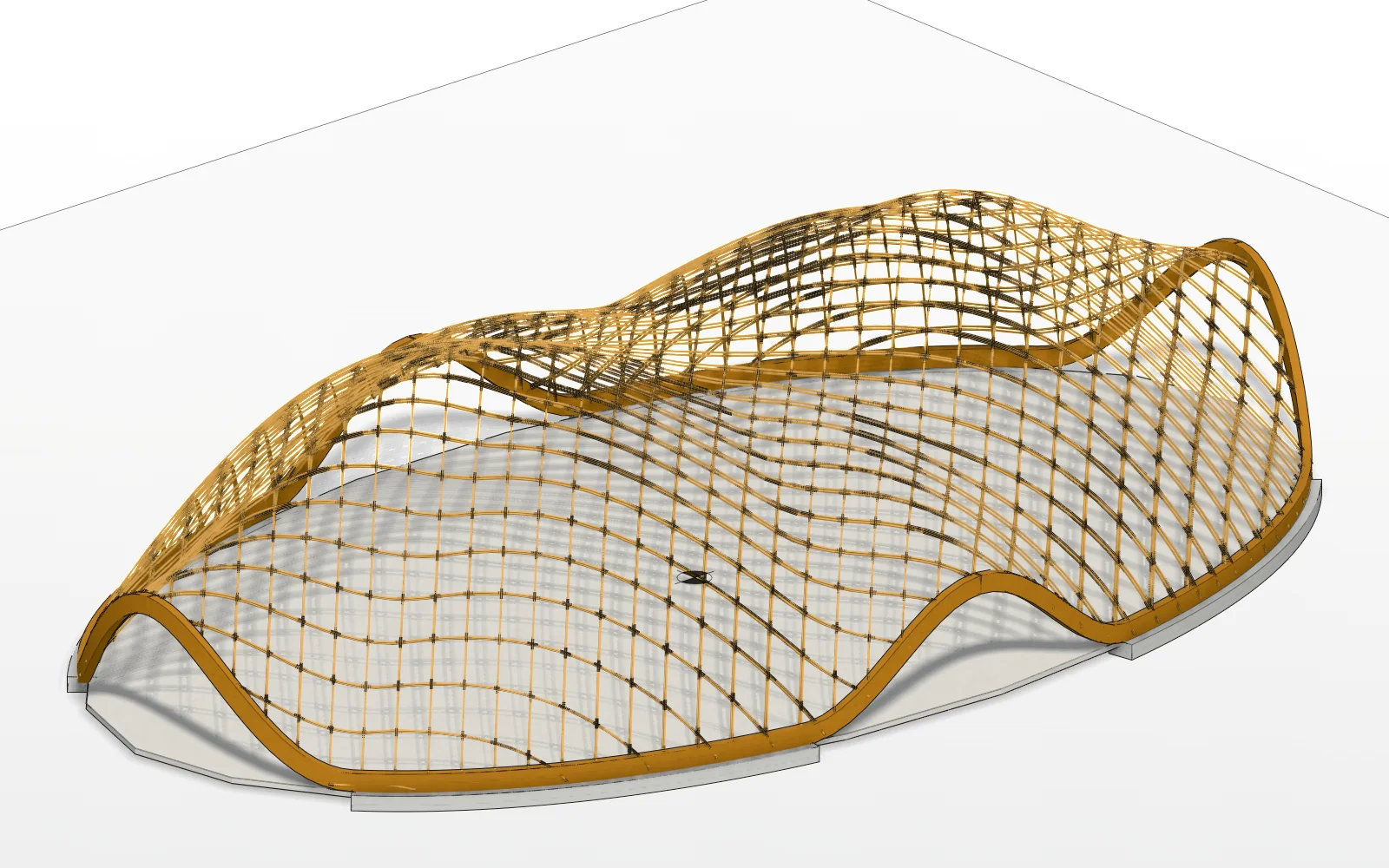
A double-curved timber gridshell 44 m long with two domes, arched openings and no columns: four layers of bent laths, an edge beam that rises into the arches and a membrane, modelled as BIM in Calq.
- Size
- 44 x 26 m
- Height
- 10 m
- BIM elements
- 158
- Structural members
- 148
- Made with
- Calq, with a script that runs inside it
Open the model, turn it, cut it, and make a copy of your own.
The building
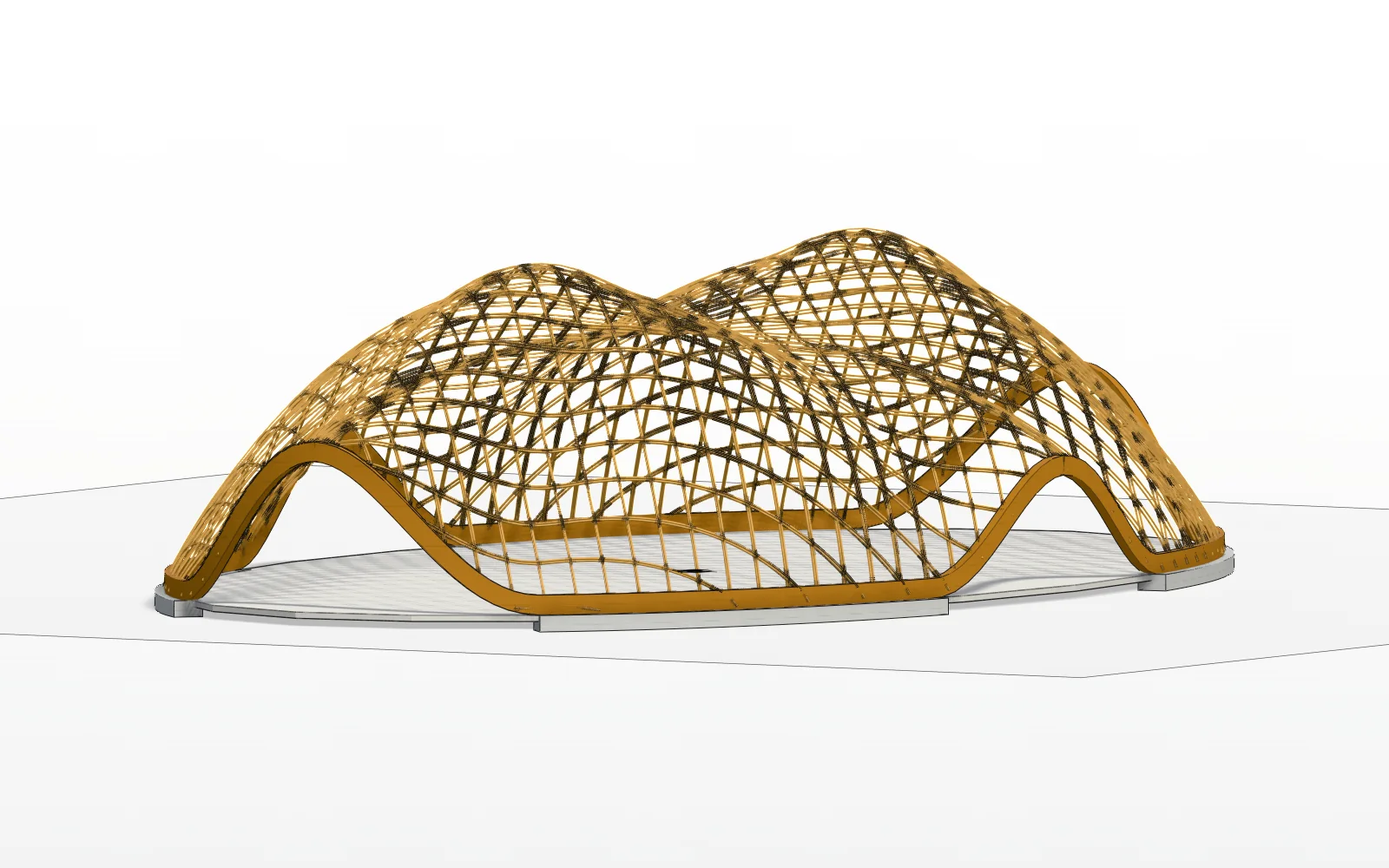
A hall 44 by 26 metres under a single timber shell. The shell stands on its own edge: no column inside. It rises to two domes 10 metres high with a saddle between them, and lifts off the ground in four arches, one at each end and one on each side, which are the ways in.
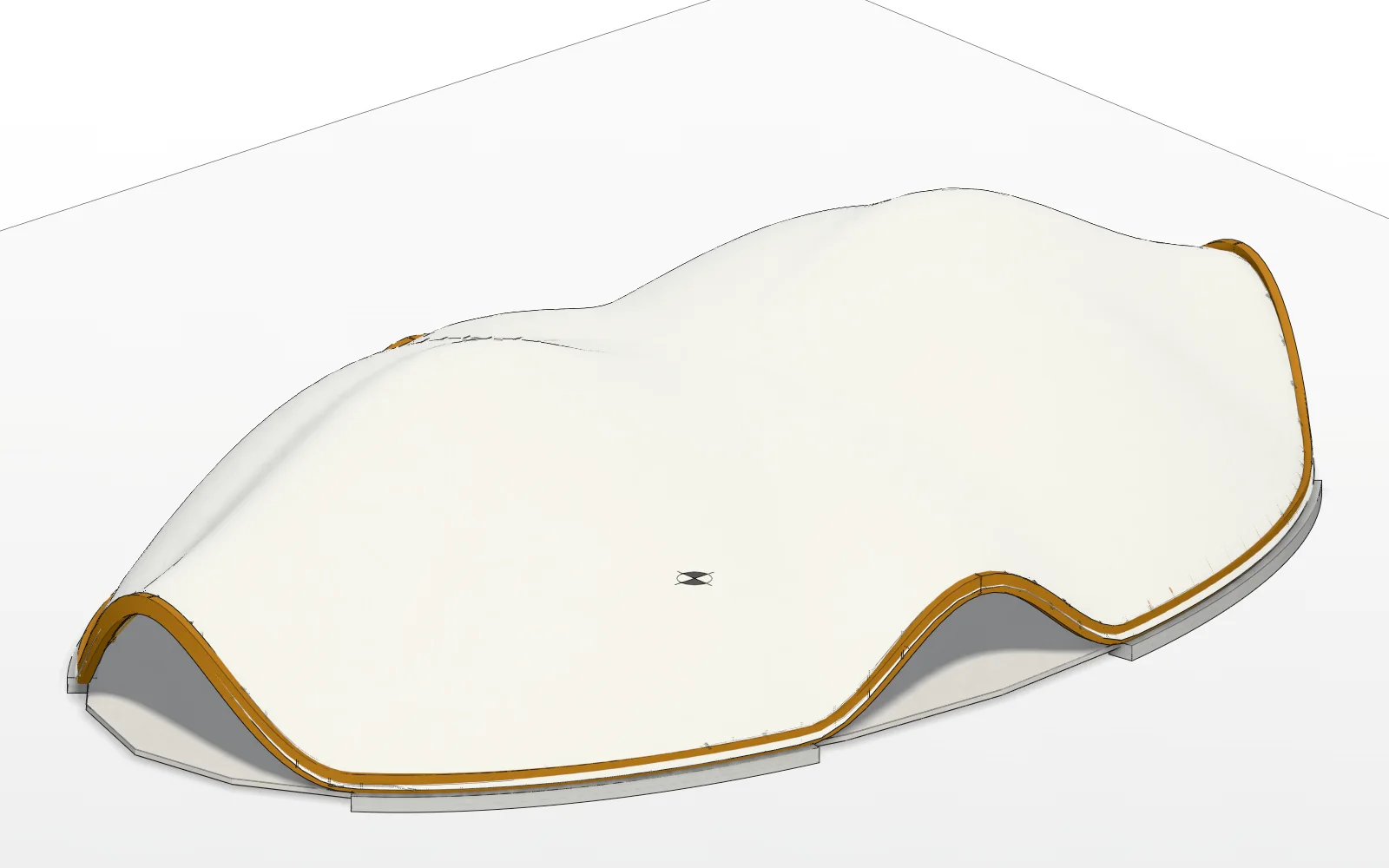
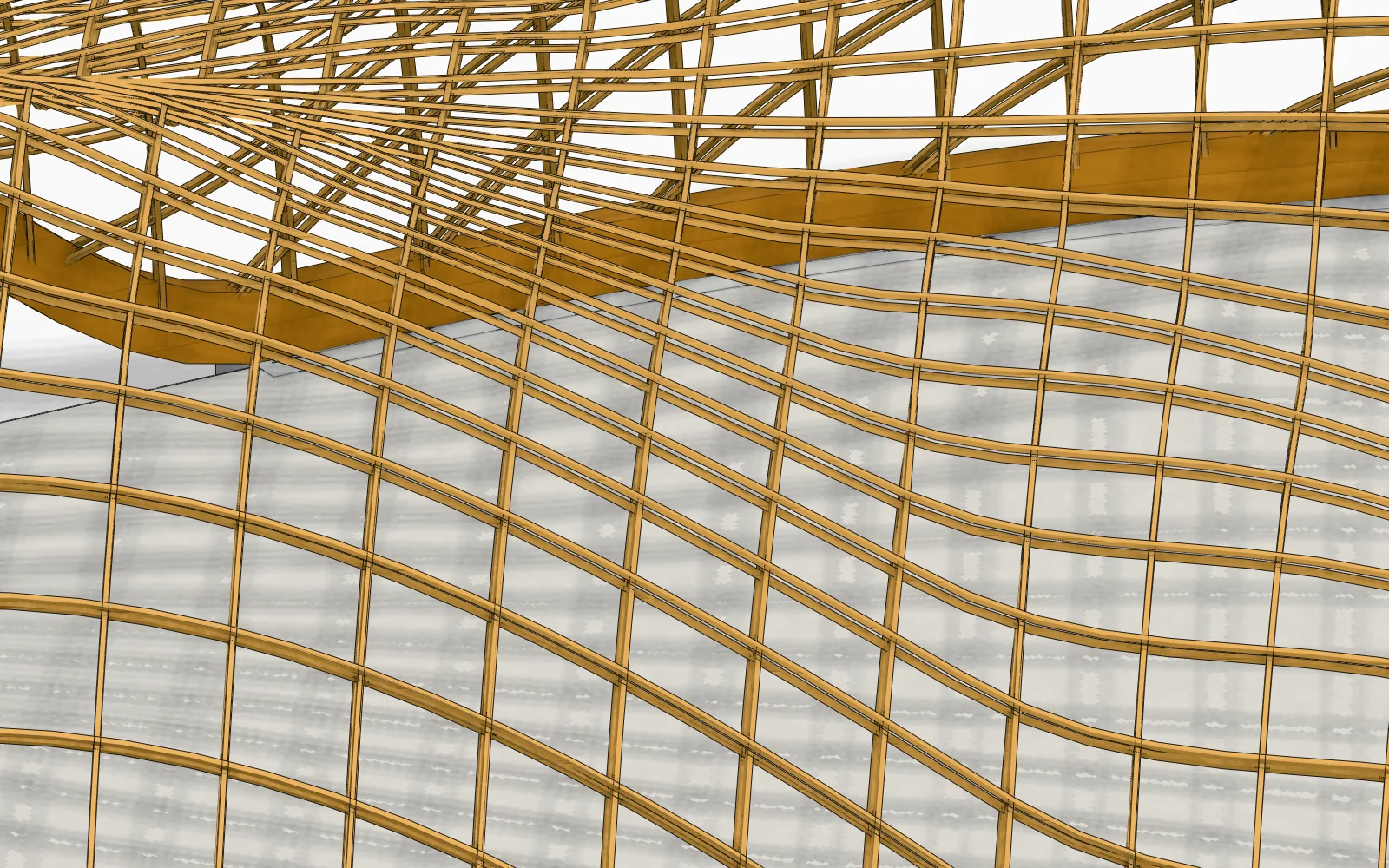
Like the great lath gridshells, it is woven from straight thin laths bent on site: 50 by 50 mm, a metre apart, in two directions at 45 degrees to the hall, two layers each, four in all. At the ground it sits on a glulam edge beam that runs along a strip footing and rises into each arch. A PTFE membrane covers it.
The model has 148 laths, each an IfcMember with its direction, layer and length, the edge beams as IfcBeam, the footings as IfcFooting and the membrane as IfcCovering, in one assembly.
How Calq was used
- A shell from its edgeThe plan is an ellipse. Its edge stands at the ground except where an arch lifts it, up to 4.6 m at the ends and 3.4 m at the sides. The crown height runs along the hall as two humps, 7.2 m at the saddle and 10.8 m at the domes, and the surface falls from the crown to the edge as the 0.8 power of what is left of the ellipse, so it springs steeply from the ground like a real gridshell.
- Laths on the diagonalTwo families of lines at plus and minus 45 degrees, a metre apart, are clipped to the ellipse, sampled more finely near the edge where the shell is steep, and lifted onto it. Each of the four layers sits 55 mm further out along the surface normal.
- The edge and the skinThe edge beam follows the ellipse at the shell's own edge height, so it is a ground beam where the shell sits and an arch where it lifts; the footings are laid only where it touches the ground. The membrane is the surface lifted above the top layer, closed into a thin solid.
- In two runsThe lower two layers went in one run of run_script, the upper two with the edge, the footings and the membrane in a second, each one undo step, with no problem for the checker.
The Calq tools in this model
- create_model
- set_levels
- create_slabs
- run_script
- view_model
- check_model
IFC classes
- IfcMember
- IfcBeam
- IfcFooting
- IfcCovering
- IfcSlab
Drawings
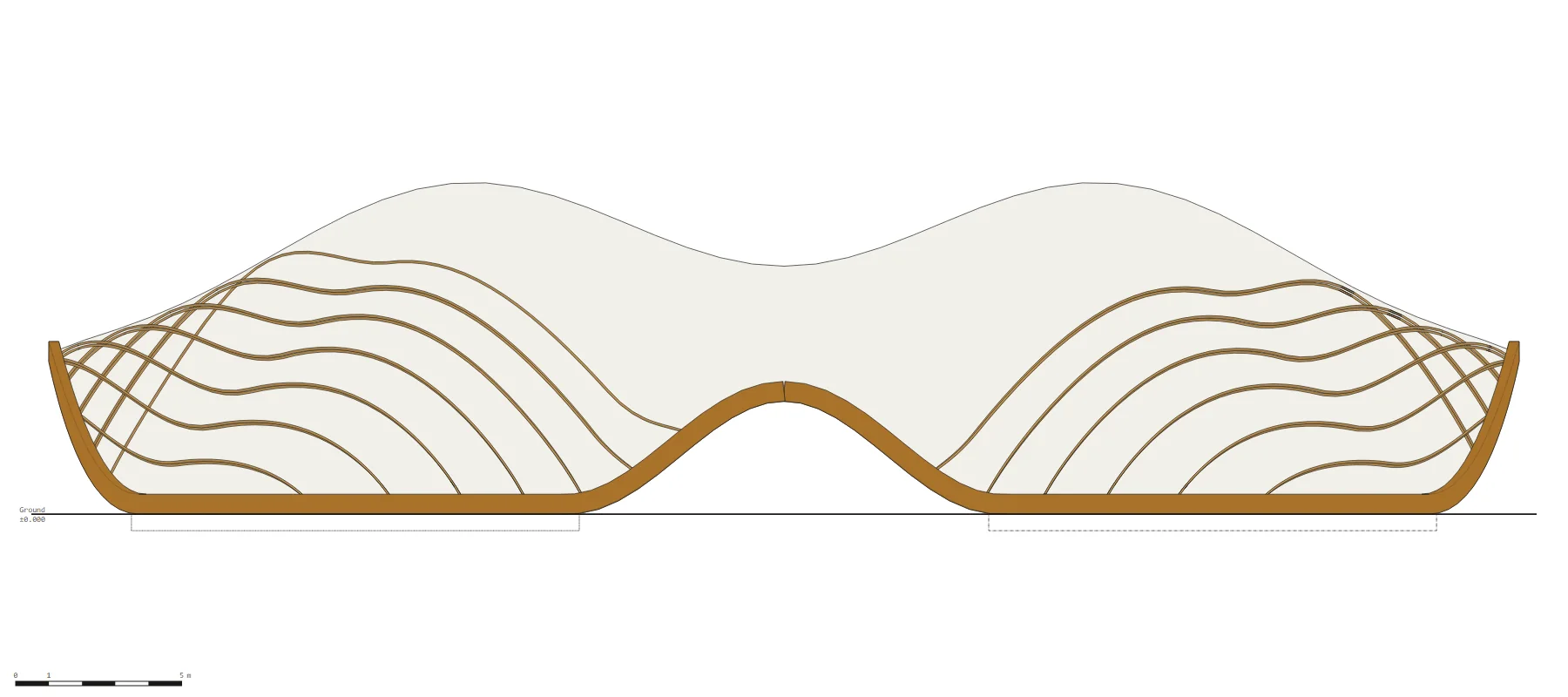
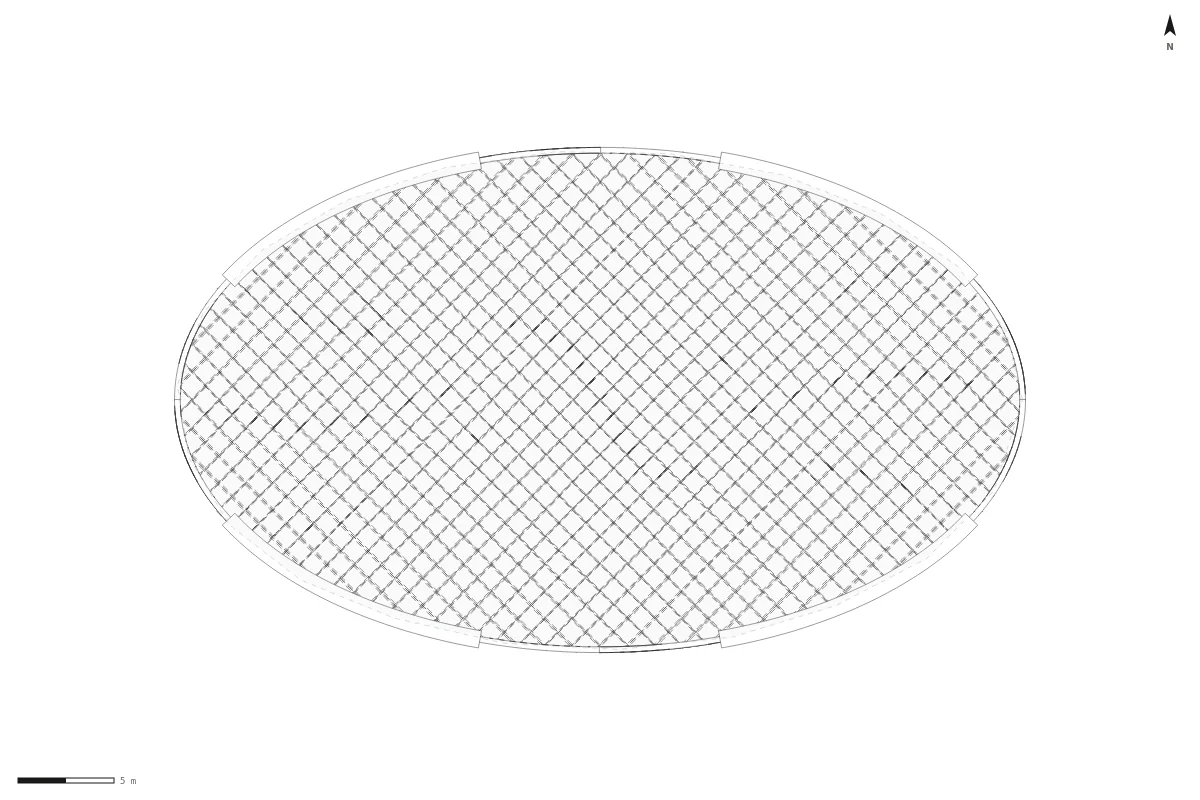
Make one like it
- Choose the plan and the openingsDraw the footprint, here an ellipse, and decide where the shell lifts off the ground and how high each arch is.
- Write the crown and the fallWrite the height along the hall (one dome, two domes, a long vault) and how fast the surface falls to its edge. A steeper fall gives the upright springing of a timber gridshell.
- Lay the lathsLay two directions of laths on the diagonal at a spacing you choose, two layers each, and sweep each as a small square section.
- Close itAdd the edge beam along the footprint at the edge height, the footings where it touches the ground and a membrane over the top, then look at an elevation and the plan.
Or ask Calq AI
Make a timber gridshell 44 x 26 m on an elliptical plan with no columns: two domes about 10 m high with a saddle between them, arched openings at both ends and both sides, four layers of 50 x 50 mm laths at plus and minus 45 degrees, 1 m apart, a glulam edge beam that runs on a strip footing and rises into the arches, and a PTFE membrane over it. Lay it with run_script in two runs, then show me the south elevation and the plan.
Paste this into Calq AI on a new model, or send it from ChatGPT or Claude through the Calq connector. Change the figures to make it yours.
Questions
Can Calq model a timber gridshell?
Yes. This shell is 148 laths in four layers, each a closed solid with its IFC class, on an edge beam that becomes the arches. Calq also has a gridshell tool for a regular grid on a surface; this free-form one was laid with a script inside Calq.
How are the openings made?
The shell's edge is lifted where an opening is wanted, so the surface springs from an arch instead of the ground. The edge beam follows the same edge, which makes it the arch.
Is the shell checked for buckling?
No. It is a design model: the laths are not analysed, and a real gridshell would be form-found and checked by an engineer.
Every picture is the real model: the 3D taken from Calq's board in the Realistic display, the drawings drawn by Calq's own sheet writers. Nothing is rendered by AI.
Topics
- timber gridshell
- double-layer lath shell
- long-span timber
- double curvature
- free-form roof
- computational design
- BIM
- IFC
More made with Calq
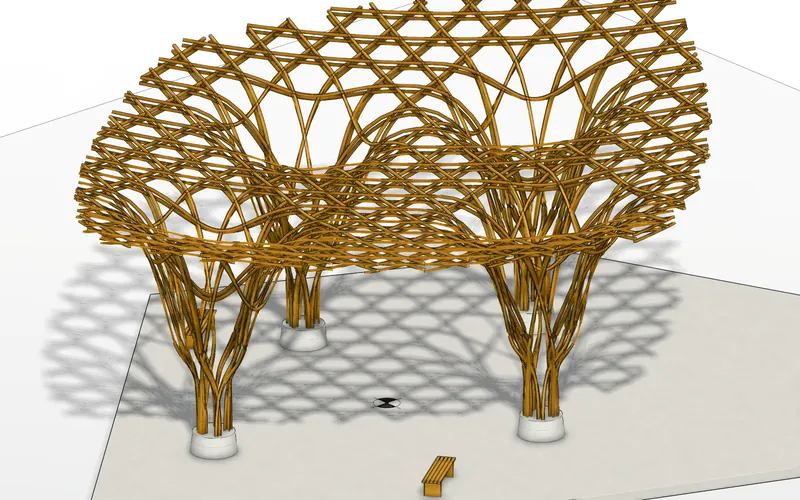 Woven timber pavilion: a parametric gridshell on tree columns150 curved members in six layers, woven at 0, 60 and 120 degrees, dropping into four braided tree columns.
- 26 x 20 m
- 158 BIM elements
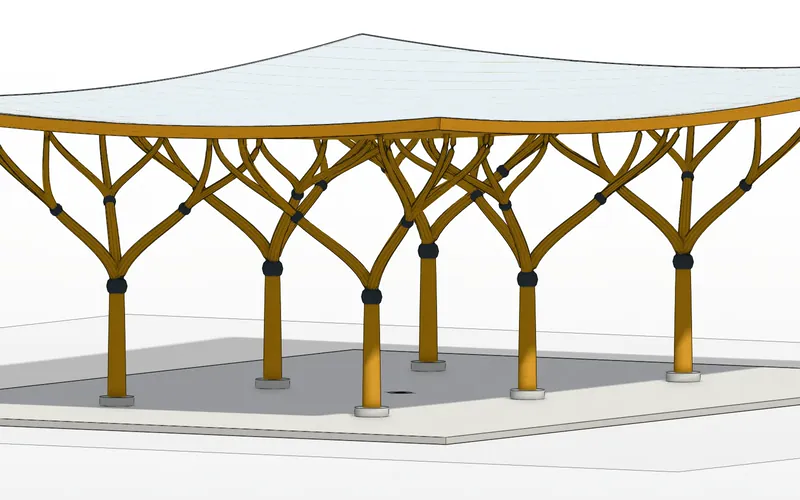 Branching tree columns: six timber trees carrying a roof gridSix trees that fork twice on cast nodes into a three-way glulam roof grid 11 metres up.
- 40 x 28 m
- 163 BIM elements
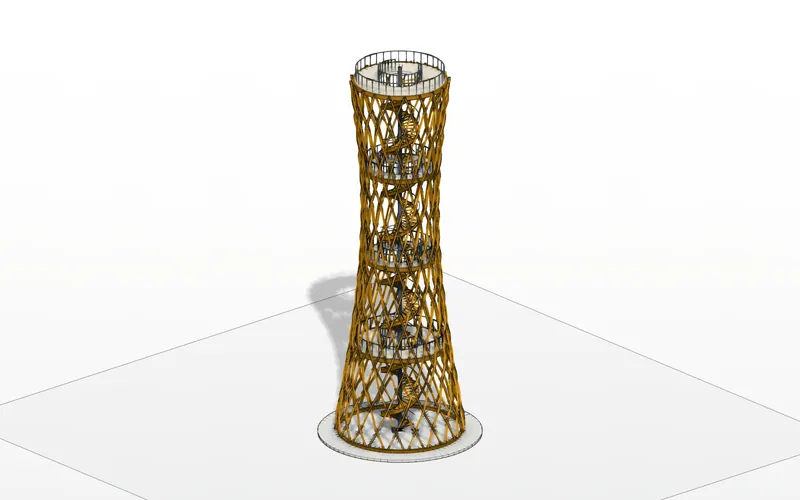 Woven hyperboloid tower: a 32 m timber observation towerForty glulam helices woven over and under on a hyperboloid, four decks and a spiral stair through the core.
- 11.2 m across at the base
- 68 BIM elements
Comments
No comments yet. Be the first.
Comments are public and show your Calq name. Be kind: comments that do not belong are removed.